 Login
Login


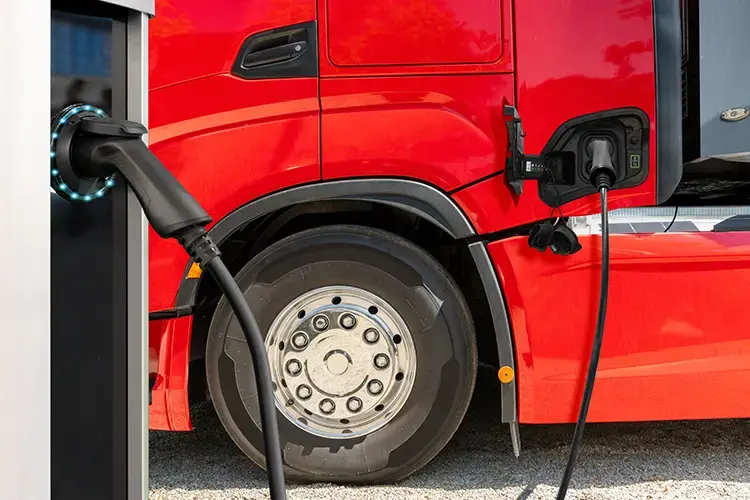

A recent study commissioned by the NGO Transport & Environment (T&E) and conducted by Fraunhofer ISI and the Öko-Institut examines the importance of charging infrastructure at logistics depots – with interesting results.
Depot charging: An underestimated game-changer
The analysis shows that about 87 percent of truck trips in Germany are regional – mostly under 150 km per trip. Furthermore, in Germany, France and the United Kingdom, 40 to 50 percent of heavy-duty trucks travel less than 300 km per day. These are distances that can easily be covered by depot charging. Public charging infrastructure is not absolutely necessary here. Rather, the depot becomes the central energy hub for the transport fleet.
The study shows that depot charging offers an economically viable, operationally practical and technically feasible way to rapidly electrify large portions of freight transport.
The experts distinguish between three forms of depot charging:
- Private depot charging: Charging on the company’s own premises, exclusively for its own fleet
- Semi-private depot charging: Partners and subcontractors use the charging infrastructure
- Semi-public depot charging: Shared charging points for clearly defined user groups, e.g., in jointly used industrial parks
Challenges in expanding charging infrastructure
About 70 to 80 percent of transportation companies in Europe are small businesses with a maximum of five trucks. These companies are reliant on short-term contracts and low margins – making investments in electric trucks and charging infrastructure nearly impossible to manage. Thus, despite technical feasibility, major hurdles remain.
A key obstacle is the lengthy and expensive grid connection process, as well as the lack of planning and investment certainty, particularly for smaller companies. In addition, the approval process in Germany often takes several years. One issue is that the “first mover” often bears the full cost of the connection.
The study recommends coordinated approaches for the shared use and financing of charging stations. However, current funding in Germany is insufficient. The national subsidy programme for climate-friendly commercial vehicles expired in early 2024. The new federal government shares this view and aims to give new momentum to electric mobility in heavy-duty transport as well as for passenger cars with its new eight-point subsidy programme.
Among other things, the goal is to accelerate the purchase of climate-friendly commercial vehicles and the expansion of charging infrastructure – particularly at commercial depots. In addition, zero-emission trucks are to be exempt from tolls beyond 2026.
Recommendations for action
Recommendations from the study’s authors include supporting the expansion of the charging network through the following measures:
- Targeted funding for small and medium-sized enterprises (SMEs) to expand charging infrastructure
- Requiring property owners to allow charging infrastructure on their properties
- Transparent grid capacity data to facilitate better planning of the expansion
- Incentives for bidirectional charging (vehicle-to-grid) to relieve strain on the grid and generate revenue
Set the course now
Depot charging is key to the decarbonisation of freight transport. The technology is here, the potential is enormous, but political will and economic incentives are needed to achieve a breakthrough.
As a leading mobility service provider, UTA Edenred is supporting this transformation. With solutions covering energy, billing and access to charging infrastructure, UTA Edenred helps fleet operators introduce e-mobility in a cost-effective manner. It provides:
- Multi-energy solutions for diesel, electricity, HV100 and other alternative energy sources
- Access to charging infrastructure, including on semi-private or semi-public depot sites
- Transparent billing systems for mixed fleets
- Consulting and services for energy contracts and CO₂ accounting
Charging infrastructure starts at the depot - and with the right partner
The transition to climate-friendly, heavy-duty transportation is not a solo effort. It requires strong partners who combine energy, technology and expertise. Depot charging offers the greatest potential for the rapid rollout of electric trucks, and UTA Edenred ensures that this transition succeeds economically and seamlessly.
Want to know how to prepare your fleet for electric mobility? Contact UTA Edenred for advice on depot charging, funding opportunities and mobility solutions for your truck fleet.
The full study is available here.