 Login
Login




Electric mobility continues to grow in Europe, but in many corporate fleets, the transition is proceeding more slowly than expected. From our perspective at UTA Edenred, this isn’t due to a single cause, but rather to several practical challenges in day-to-day fleet operations.
Companies must select vehicles that match their operational requirements, organise charging infrastructure, set up reimbursement processes, and have the capability to manage costs transparently. It’s precisely these factors that determine whether electric mobility works in day-to-day operations.
Commercial fleets play a central role in this process.
Table of Contents
Companies are a key market for e-mobility
Why many companies are hesitant to make the switch
Why electrifying fleets is worth it
How the market is evolving in Europe
How UTA Edenred supports companies in the transition
Conclusion
Companies are a key market for e-mobility
In Germany, according to the Federal Motor Transport Authority, commercial owners account for roughly two-thirds of new vehicle registrations. In the BEV segment, commercial registrations have a significant impact on the market. For fleet managers, this means fleet-related decisions have a direct impact on the pace of the mobility transition.
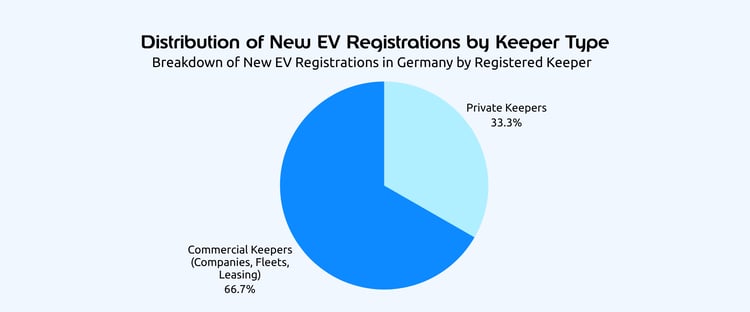
Source: Federal Motor Transport Authority – New Registrations
Corporate fleets are a key driver not only in Germany but across Europe. Market reports over recent years from the European Automobile Manufacturers Association (ACEA) have shown that the transformation of the passenger car market will only accelerate if fleet vehicles become more electrified. Companies purchase vehicles in large quantities and return them to the used car market after a few years. In doing so, they influence not only initial registrations but also, indirectly, the availability of electric vehicles across the entire market.
At the same time, developments across Europe remain varied. Data from the European Alternative Fuels Observatory (EAFO) shows that the adoption of electric vehicles and the density of public charging infrastructure vary significantly from country to country. This is an important consideration for companies operating internationally, because the feasibility of electric fleets depends not only on the vehicle but also on conditions along the route taken.
Why many companies are hesitant to make the switch
At UTA Edenred, we see the same hurdles time and time again. These relate less to a willingness to make the switch than to the actual implementation.
1. Charging infrastructure is more complex than traditional refuelling
The biggest difference between internal combustion engine fleets and electric fleets lies in the energy supply. While refuelling has been a standardised practice for decades, companies must consider multiple charging scenarios when it comes to electric vehicles. These include:
-
Charging on corporate premises
-
Charging at drivers’ homes
-
Public charging on the go
-
Charging in other European countries
This creates a more complex system, particularly for field service fleets or employees with varying work locations. The European Union recognises the importance of this issue. The Alternative Fuels Infrastructure Regulation (AFIR) is intended to drive the expansion of alternative charging and fuelling infrastructure in Europe. For fleet managers, this demonstrates that charging infrastructure is critical for success.
2. Charging electric cars at home makes practical sense, but is logistically challenging
Many company car drivers charge their vehicles at home because it’s convenient. For companies, however, it can pose challenges. Electricity costs must be accurately tracked, business and personal use must be clearly separated, and reimbursements must be processed in a transparent manner. Without digital processes, this effort can quickly become overwhelming.
This is precisely why electric mobility in fleet operations needs solutions that not only enable charging but also simplify the subsequent cost tracking and billing.
3. Cost-effectiveness is often assessed too narrowly
A common reason for hesitation lies in the economic assessment. In many companies, the higher purchase price of an electric vehicle is a primary concern at first. However, total cost of ownership (TCO) – that is, the total costs over the entire useful life of a vehicle – is crucial for making a sound decision. This includes, among other things:
-
Purchase costs
-
Energy costs
-
Maintenance and wear-and-tear costs
-
Infrastructure costs
-
Tax framework
-
Residual value trends
Analyses and market observations show that the cost-effectiveness of electric vehicles depends heavily on their usage profile. For fleet managers, this means that reliable decisions are based not on blanket assumptions, but on a well-founded TCO analysis using their own fleet data.
4. Electric mobility requires new fleet management processes
Many fleet managers have ample experience with diesel and petrol vehicles. However, electric mobility places additional demands on processes and management. These include:
-
Charging planning
-
Selection of suitable vehicles based on driving profiles
-
Integration of charging stations
-
Reimbursement of home electricity costs
-
Data and cost reporting
-
Monitoring of usage and CO2 savings
From our perspective, the transition to e-mobility isn’t just a vehicle issue, but a management and process project.
Why electrifying fleets is worth it
Despite the obstacles mentioned, there are many reasons for companies to switch to an electric fleet.
Operating costs can be reduced in the long term
Electric vehicles offer economic advantages. Maintenance and wear and tear are often lower than with combustion engine vehicles. Added to this are potentially lower energy costs per kilometre, depending on the charging location and the price of electricity. The actual cost savings depends on the specific usage profile, but the trend is clear: Looking at total costs rather than individual prices provides a more realistic picture.
ESG and sustainability goals are becoming more important
Companies are under increasing pressure to track and reduce emissions. Electric vehicles can make a concrete contribution to decarbonisation, ESG goals and reporting requirements.
How the market is evolving in Europe
For fleet managers, it’s worthwhile to look at Europe. Market and infrastructure developments show that electric mobility is no longer a niche topic, though its expansion is proceeding at different rates across different regions.
ACEA regularly publishes reports on new passenger car registrations and charging infrastructure in Europe. These make it clear that a large proportion of public charging stations continue to be concentrated in just a few countries. In addition, data from the European Alternative Fuel Observatory (EAFO) indicates that the distribution of charging points and electric vehicles varies greatly across Europe. This is highly relevant for international fleets: Those who need to travel across Europe require not only suitable vehicles but also reliable access to charging stations.
How UTA Edenred supports companies in the transition
For electric mobility to work in day-to-day fleet operations, what’s needed isn’t multiple solutions, but rather an integrated approach. This is where UTA eCharge comes in.
Charging Across Europe with a Single Solution
With UTA eCharge, companies gain access to a Europe-wide charging network. This is relevant for fleet managers because charging processes can be centrally managed and billed transparently. This provides greater clarity for cross-border trips or decentralized teams.
Transparent billing for home charging
When employees charge their company cars at home, electricity costs must be accurately tracked and reimbursed. UTA eCharge helps make these processes transparent and efficient, reducing administrative overhead and enabling companies to keep track of costs.
Centrally manage electric mobility
Professional fleet management requires transparency. With a centralised solution like Spirii’s Connect Dashboard, the following data can be analysed more effectively:
-
Charging sessions
-
Energy costs
-
User behavior
-
Vehicle data
-
CO2 savings
This makes electric mobility not only technically feasible, but also economically viable.
Conclusion
From our perspective, the question today isn’t whether companies will electrify their fleets, but rather how they’ll go about doing so. The biggest hurdles lie less in vehicle technology than in the organisation of charging infrastructure, cost control, home charging and process integration.
For fleet managers, a holistic approach is crucial. Those who understand electric mobility as a comprehensive system and establish appropriate processes early on lay the foundation for a cost-effective and scalable transition. With UTA eCharge, we help companies reduce this complexity and make electric mobility a practical reality in day-to-day fleet operations.