

Tolls in Great Britain

tolls-united-kingdom-uta-edenred

There is no general road toll for cars in Great Britain. However, trucks over 12 tonnes that have not been registered in the UK must pay the HGV Levy to use the road network. Additional rules apply on individual routes, bridges and in city zones.

  • information-circle-interface-essential-red

    HGV levy: Mandatory for trucks over 12 tonnes not registered in the UK

  • information-circle-interface-essential-red

    No carbon toll: Invoicing is based on route and vehicle class

  • information-circle-interface-essential-red

    Introduction of a carbon toll is planned

tolls-united-kingdom-card

General information

Toll provider: HVG Levy

The toll in Great Britain supports the financing and maintenance of toll roads. It helps to maintain and modernise the road network. HGV Levy is responsible for collecting and managing the truck toll, while the respective route operators are responsible for cars.

The toll is collected depending on the route: Passenger cars and motorcycles pay depending on the route, while trucks over 12 tonnes are tolled according to vehicle class, weight and emissions class. Some bridges or sections of road may incur additional charges.

There is currently no CO₂ toll. The system primarily serves to provide efficient and transparent billing for all vehicle types.

delivery-truck_multicolor Vehicles subject to tolls

In Great Britain, a route-dependent mandatory toll applies on select routes. Passenger cars and motorcycles pay the toll directly at toll booths or online, while trucks over 12 tonnes are billed by vehicle class and weight via electronic vignette (HGV Levy).


Valid for vehicles Route Payment options
Trucks > 12 tonnes

All roads

Electr. vignette (HGV Levy): Processing possible via UTA Card 

All vehicles

M6 motorway

Payment with Key Fuel card only possible for UK customers
Processing with UTA Card, cash, credit/debit card or OBU possible

streamline-icon-truck-cargo-1@1200x1200 (2)Trucks tolls in Great Britain

The truck toll in Great Britain regulates the use of toll roads for heavy goods vehicles. Unlike in many European countries, there are mainly open toll systems where billing takes place flexibly. An exception is the M6 Toll Road, a closed toll system in which the toll is calculated on the route travelled. No additional CO₂ toll is currently charged.

Vehicles over 12 tonnes subject to tolls

All trucks with a total permissible weight of more than 12 tonnes are subject to tolls on certain roads. Invoicing takes place either electronically or at stationary toll booths. Transport companies should carefully plan their routes, as toll charges may vary by route section.

Toll-exempt vehicles

Certain vehicles are exempt from tolls. These include, for example, vehicles that are used exclusively for agricultural purposes, as well as certain emergency vehicles. Vehicles travelling within the city, which do not use toll roads, are also exempt.

Carbon toll

There is currently no carbon toll for trucks in the UK. The toll costs therefore do not depend on emissions levels. This simplifies cost planning for transport companies and ensures transparent billing without additional environmental levies.

streamline-icon-carCar tolls in Great Britain

There are tolls on certain roads and bridges in the UK. These should be taken into account when planning a route, as the charges vary depending on the vehicle class and the route used. Most motorways and country roads are freely accessible, with the exception of the M6 Toll Road, which uses a closed toll system, where the fee is calculated according to distance driven.

Vehicles are classified on toll roads according to vehicle class:

  • Class 1: Cars up to 3.5 tonnes of permissible total weight, height up to 2 m, also with smaller trailers

  • Class 2: Passenger cars up to 3.5 tonnes with a height above 2 m, e.g., camper vans or trailers with towing vehicles up to 3.5 tonnes

  • Class 5: Motorcycles (also with sidecars), trikes

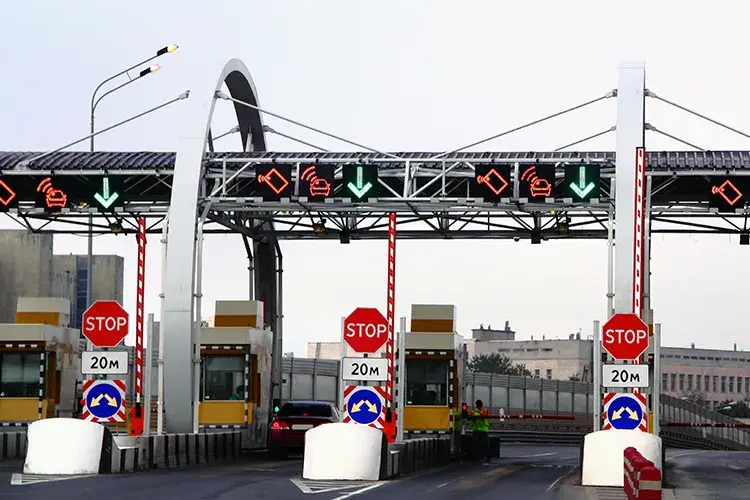
The toll can be paid directly at toll booths, via electronic systems or apps. Electronic payment is particularly practical for the M6 Toll Road: Vehicles are automatically recorded and the fees are paid online within a short time.

The car toll in Great Britain thus offers a simple and transparent way to use toll roads and special routes. Electronic payment systems make processing convenient, while travelling on toll routes without payment can lead to fines.

streamline-icon-trip-distance@1200x1200 Overview of toll routes

In the UK, all motorways include a mandatory toll for trucks over 12 tonnes if they are not UK-registered. Buses are exempted. On some toll roads, such as the M6, other categories of vehicles, such as cars and motorcycles, are also subject to tolls.

For trucks with a total permissible weight of more than 12 tonnes, there is a mandatory toll on certain routes, while cars usually only have to pay tolls on special routes or in city toll zones (e.g., London). There is currently no carbon toll.

Below is a list of important toll roads and bridges in the UK, separated by truck and car.

Bruecken-Tunnel-uta-plus-services-uta-edenred

road-straight-transportation-multicolor Motorways

icon-road-tunnel-multicolor Tunnels & bridges

streamline-icon-car Car transport

icon-trip-road-multicolor City toll

streamline-icon-credit-card-giveToll payment

In the UK, there are different billing options depending on vehicle type:

For vehicles up to 3.5 tonnes

Passenger cars, motorcycles and light commercial vehicles only pay on selected toll roads, bridges or in city zones. Invoicing usually occurs at the toll office or electronically via apps and online portals.

This system is simple and flexible and is particularly suitable for occasional drivers who use toll routes sporadically.

For vehicles over 12 tonnes

Trucks over 12 tonnes from abroad are subject to the HGV Levy, which is collected depending on distance and weight. The calculation is carried out according to vehicle class and weight, while a carbon toll does not currently exist.

There are various options available for billing:

  • Online portals and apps for digital payment

  • Toll stations where the fee can be paid directly

This system is transparent and route-dependent, enabling companies to precisely control transport costs.

Discover neighbouring countries where tolls apply