


Tolls in France

tolls-france-uta-edenred

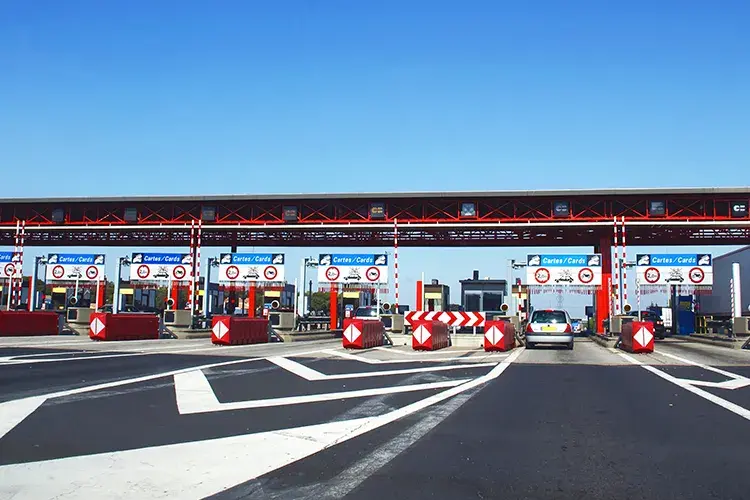
In France, much of the motorway network is subject to tolls. Fees are charged by operating companies and are based on vehicle type, number of axles, height and emissions class. Only a few sections, such as urban motorway bypasses or cross-border routes in Alsace, are toll-free.
  • information-circle-interface-essential-red

    Which vehicles are subject to tolls?​

  • information-circle-interface-essential-red

    Two toll systems: Barriers or automatic free-flow

  • information-circle-interface-essential-red

    Special routes cost extra

tolls-france-card

General information

In France, the toll system helps to finance the transport infrastructure. It contributes to the preservation, modernisation and expansion of motorways, tunnels and bridges. Various private and state companies that operate the system in accordance with national regulations are responsible for toll collection and administration.

Since the toll system was introduced, costs for the construction, operation and maintenance of roads are mainly covered by toll fees. Various payment systems such as cash, credit card, toll cards or electronic systems (Télépéage) ensure flexible and transparent processing for occasional drivers and commercial transport operators.

As part of France’s climate targets, a vehicle’s emissions class is factored into the toll calculation: Vehicles with higher emissions pay more, while environmentally friendly vehicles benefit from discounted rates. The goal is to make road traffic more sustainable and to promote the use of climate-friendly technologies.

delivery-truck_multicolor Vehicles subject to tolls

In France, a mandatory toll applies to trucks over 3.5 tonnes of permissible total weight. Invoicing is calculated to the exact kilometre and is based on vehicle class, number of axles, weight and emissions class (carbon toll). Cars, motorcycles and motor homes up to 3.5 tonnes must pay a toll on most motorways based on route travelled, vehicle height and class. In addition, special fees apply on special routes, including some tunnels and bridges as well as environmental zones.


Valid for vehicles Route Payment options
Trucks > 3.5 tonnes or over 3 m high

Motorways, bridges, tunnels, car parks

UTA One® next toll box; Telepass EU toll box; UTA MultiBox®light / light vario toll box; UTA MultiBox® toll box

HGV > 3.5 tonnes

Fréjus and Mont Blanc Tunnel

Toll card TMB / Fréjus Card or payment via UTA Card possible

Car ≤ 3.5 tonnes and max. 3 m height incl. trailer

Motorways, bridges, tunnels, car parks    

UTA MultiBox® Liber-t toll box; UTA One® Move toll box

Passenger cars ≤ 3.5 tonnes

Fréjus and Mont Blanc Tunnel

Payment possible via UTA Card

streamline-icon-truck-cargo-1@1200x1200 (2) Truck tolls in France

In France, trucks over 3.5 tonnes have a closed toll system on almost all motorways. Fees are usually charged when you leave the toll route at toll booths. The toll amount depends on distance driven, vehicle class, number of axles and emissions class. There are additional charges on certain toll routes, such as the Mont Blanc Tunnel or Fréjus Tunnel. There are only isolated toll-free sections, so  the use of toll roads on most routes is unavoidable.

Vehicles over 3.5 tonnes subject to tolls

Vehicles over 3.5 tonnes must generally pay a toll on tolled motorways. The classification is based on vehicle class, number of axles and emissions class. The French system distinguishes between:

  • (Télépéage Inter Sociétés - Poids Lourds) for vehicles over 3.5 tonnes or a height over 3 metres (Classes 3 & 4).

Payment is flexible: cash, credit card, toll card or electronic Télépéage solutions that allow automatic passage through the toll booths. On some motorways, tolls are billed electronically via free-flow systems, where fees must be paid online within 72 hours.

Toll-exempt vehicles

Certain vehicles are exempt from tolls. These include emergency, agricultural and public service vehicles. The payment obligation also lapses for vehicles that are only on toll-free routes.

Carbon toll

France factors the emissions class of trucks into its tolls. Vehicles with low-emissions drives benefit from reduced fees while trucks with higher emissions pay more. This system promotes the use of environmentally friendly vehicles and supports the reduction of CO₂ in road traffic.

streamline-icon-car Car tolls in France

In France, tolls are charged on almost all motorways. This should be taken into account when planning a route, as the amount of the fees is calculated according to vehicle category, vehicle height and distance driven. In addition, certain tunnels, bridges and in some cities (e.g., Paris, Lyon, Bordeaux, Marseille, Toulouse) charge fees for environmental stickers or city tolls. Invoicing is undertaken at toll offices or electronically.

Vehicles are classified on toll roads according to vehicle class:

  • Class 1: Passenger cars up to 3.5 tonnes of permissible total weight, height up to 2 m, even with smaller trailers.

  • Class 2: Passenger cars up to 3.5 tonnes with a height between 2 and 3 m, e.g., camper vans or trailers with towing vehicles up to 3.5 tonnes

  • Class 5: Motorcycles (also with sidecars), trikes

The toll can be paid at toll booths or operator facilities or via electronic toll systems (Télépéage) with automatic passage or free-flow system, in which vehicles are automatically recorded and fees paid online within 72 hours.

The car toll in France thus offers a simple and transparent way to use motorways and special routes. Electronic payment solutions such as Télépéage or the free-flow system make processing convenient, while driving without paying can lead to fines.

streamline-icon-trip-distance@1200x1200 Overview of toll routes

The mandatory toll in France extends to almost the entire motorway network (autoroutes) as well as certain bridges, tunnels and dual carriageways. The system is managed by several private and state operators. The toll helps to finance, maintain and modernise French transport infrastructure.
 
You can find a current map of the French toll network here .

icon-road-sign-multicolor Bridges

tolls-denmark-uta-edenred

streamline-icon-car City toll

icon-road-tunnel-multicolor Tunnel

streamline-icon-credit-card-giveToll payment

In France, depending on the vehicle type, the toll is paid via different systems that enable simple and transparent processing.

For vehicles up to 3.5 tonnes

  • For cars, motorbikes and campervans up to 3.5 tonnes, tolls apply on most motorways.
  • Payment can be made in several ways: At toll booths cash or by credit card via operating company toll cards or electronically via Télépéage systems or free-flow payment, in which the toll is automatically recorded and settled online within 72 hours.
  • On some special routes, such as tunnels or bridges (e.g., Mont-Blanc Tunnel, Fréjus Tunnel), light vehicles must pay additional fees.

For vehicles over 3.5 tonnes

  • For trucks over 3.5 tonnes, there is a mandatory toll on motorways. The calculation is carried out to the exact kilometre and depends on vehicle class, number of axles, weight and emissions class.
  • Payment takes place via electronic toll boxes/on-board units (OBU) or digital toll tickets.
  • Companies can pay fees via online portals, apps or authorised service providers, facilitating cost control and transparency.
 

Driving through other European countries? Then we recommend our UTA One® next EETS toll box, which automatically records all tolls and settles them via post-paid procedure.
EETS stands for European Electronic Toll Service. It enables Europe-wide toll settlement via a uniform system that eliminates the need for separate toll devices and contracts in each country.