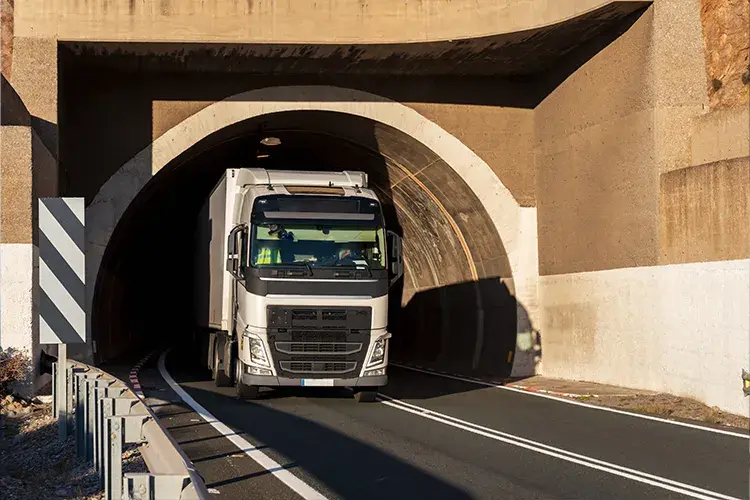


Usage on Swiss motorways and national roads is subject to tolls. Vehicles up to 3.5 metric tonnes require a motorway vignette, while trucks over 3.5 tonnes are billed via the performance-dependent heavy-duty duty charge (LSVA). Passenger transport vehicles over 3.5 tonnes pay a flat-rate heavy transport charge (PSVA). This means that road infrastructure is financed sustainably, and all road users contribute fairly to the safety, preservation and expansion of the road network.
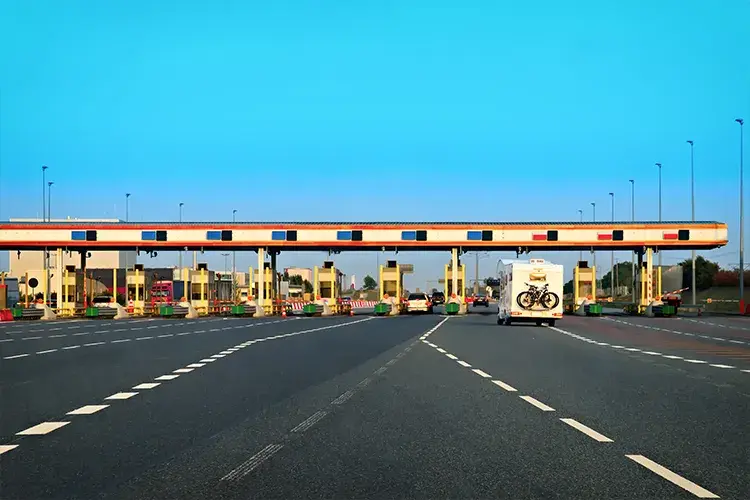
Tolls in Switzerland and Liechtenstein
-
Mandatory for all vehicles
-
Mandatory vignette for vehicles up to 3.5 t
-
LSVA (power-dependent heavy goods vehicle fee) for trucks over 3.5 tonnes
-
PSVA (flat-rate heavy goods vehicle fee) for passenger transport vehicles over 3.5 tonnes
General information
Toll provider: Federal Swiss Customs Administration (EZV) Head Customs Office, Bern
The Swiss toll system is a central part of the financing of transport infrastructure and contributes to the preservation, modernisation and expansion of motorways and national roads. The Swiss Confederation, which organises the system in cooperation with local authorities, is responsible for collecting and administering the toll.
Since the introduction of the toll system, costs for the construction, operation and maintenance of roads are primarily covered by toll fees. A distinction is made between the time-dependent passenger car vignette for vehicles up to 3.5 tonnes and the route-dependent, power-dependent heavy goods vehicle fee (LSVA) for trucks over 3.5 tonnes. Passenger transport vehicles over 3.5 tonnes pay a flat-rate heavy transport charge (PSVA). Separate tolls may be charged for specific pass roads, tunnels or bridges.
In the course of the climate targets of Switzerland, CO₂ differentiation is also included in the toll calculation: Vehicles with higher emissions pay higher fees while environmentally friendly vehicles benefit from discounted rates. The goal is to make road traffic more sustainable and to promote the use of climate-friendly technologies.
Vehicles subject to tolls
In Switzerland, almost all vehicles are subject to tolls – different regulations apply depending on permissible total weight and vehicle type. Vehicles up to 3.5 tonnes, such as cars and motorcycles, require a motorway vignette to use motorways and national roads. Trucks over 3.5 tonnes are invoiced via the power-dependent heavy goods vehicle fee (LSVA), which records the distance driven as well as weight and emissions class via an on-board unit (OBU). Passenger transport vehicles over 3.5 tonnes pay a flat-rate heavy transport charge (PSVA).
| Valid for vehicles | Route | Payment options |
| HGV > 3.5 tonnes | Motorways |
UTA One® next toll device; online webshop (www.via.admin.ch/shop) via UTA fuel card |
| Passenger transport vehicles > 3.5 tonnes | Motorways | Book the flat-rate heavy-duty duty charge (PSVA) online |
| Vehicles < 3.5 tonnes | Motorways | Vignette (handling via UTA fuel card) |
Truck tolls in Switzerland & Lichtenstein
In Switzerland and Liechtenstein, all heavy-duty vehicles are subject to tolls, which are charged in the form of a power-dependent heavy goods vehicle fee (LSVA). It helps finance, maintain and expand road infrastructure and supports environmental protection. The LSVA is managed by the Swiss authorities and also applies to Liechtenstein, since both countries use a common toll system.
Vehicles weighing over 3.5 tonnes are subject to tolls
Trucks over 3.5 tonnes are subject to the LSVA in Switzerland and Liechtenstein. Passenger transport vehicles over 3.5 tonnes pay a flat-rate heavy transport charge (PSVA). Invoicing takes place via an on-board unit (OBU), which automatically records routes, weight and emissions values. Fees vary depending on kilometres driven, total weight and emissions class of the vehicle.
Toll-exempt vehicles
Excluded from the LSVA are emergency vehicles belonging to the police, fire brigade and rescue services as well as certain agricultural vehicles. Vehicles with alternative or low-emission drives also benefit from discounts.
Carbon toll
The LSVA is carbon-differentiated and takes into account the pollutant emissions of a vehicle. Trucks with higher CO2 emissions pay higher fees while eco-friendly vehicles benefit from reduced rates. The goal is to make heavy traffic more climate-friendly and promote sustainable technologies.
Car tolls in Switzerland & Lichtenstein
In Switzerland and Liechtenstein, all cars, motorbikes and camper vans up to 3.5 tonnes of permissible total weight require a valid motorway vignette when driving on motorways and national roads. This must be visibly attached to the windscreen or registered as a digital e-vignette.
The vignette is valid for one calendar year and is offered both as a physical adhesive vignette and in digital form. This allows occasional drivers and frequent drivers to choose a suitable solution. The digital vignette eliminates the need for manual attachment, as registration takes place automatically in the system.
The cost of vignettes is uniform for cars, while camper vans or vehicles with alternative drives must observe special regulations depending on their weight. There are strict penalties for driving without a valid vignette including heavy fines imposed on site or retrospectively.
The Swiss and Liechtenstein car toll thus provides a simple, transparent and legally secure way to use motorways and national roads without incurring penalties.
Overview of toll routes
A valid vignette is required for the use of motorways and national roads in Switzerland and Liechtenstein. Trucks over 3.5 tonnes also pay a power-dependent heavy goods vehicle fee (LSVA). Separate fees may apply on individual pass roads and tunnel routes.
The Swiss Confederation provides a map of the toll network and information on specific toll routes on its website or via PDF download. More information on toll routes in Switzerland.
Tunnel
Car loading / car trains
Toll payment
In Switzerland and Liechtenstein, there are different solutions for paying tolls, depending on the vehicle type:
For vehicles up to 3.5 tonnes
- The toll is processed via the motorway vignette, which can be purchased online or at fuel stations or border shops.
- The vignette is valid for a calendar year and can either be attached to the windscreen as a physical adhesive or stored as a digital e-vignette.
- The system is simple, fast and practical for occasional drivers.
For vehicles over 3.5 tonnes
- For trucks over 3.5 tonnes, the toll is charged via the power-dependent heavy goods vehicle fee (LSVA), based on route-dependent GPS or OBU recording. Passenger transport vehicles over 3.5 tonnes pay a flat-rate heavy transport charge (PSVA).
- Vehicles can pay tolls via an on-board unit (OBU), online portals or mobile apps.
- Billing is route-dependent and transparent, enabling companies to precisely control their transport costs.
This system ensures that occasional drivers and logistics companies can pay tolls in Switzerland and Liechtenstein simply, flexibly and legally.