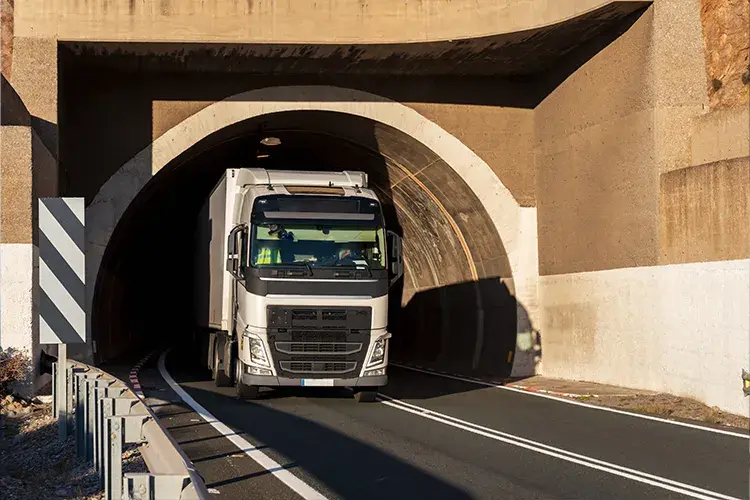



In Sweden, certain bridges and the cities of Stockholm and Gothenburg are subject to additional charges. For trucks weighing 12 tonnes or more, tolls are payable using an electronic Eurovignette.

Tolls in Sweden
In Sweden, trucks over 12 metric tonnes are subject to tolls on motorways and select dual carriageways. Invoicing is undertaken via the electronic Eurovignetten system, which enables simple, automatic and transparent payment processing. Eurovignettes must be purchased digitally in advance and the vehicle registration number must be stored. The system facilitates planning and control for fleets and drivers and helps pay for the financing, maintenance and modernisation of the Swedish road network.
-
Toll obligation for trucks above 12 tonnes – on toll motorways and dual carriageways
-
Mandatory toll on certain routes – amount depends on validity period, number of axles and a combination of carbon emissions class and Euro emissions class
-
Passenger cars: there is no general toll for passenger cars, but there are fees on certain bridges and in city toll zones
General information
Toll provider: AGES
The toll in Sweden is used to finance, maintain and modernise the national road and motorway network, especially for heavy goods vehicles. Unlike other countries, a general toll is not charged for cars on motorways. AGES, which runs the Eurovignette system, is responsible for collecting and managing the toll.
The toll is only charged on select routes and is calculated based on validity period, number of axles and a combination of carbon emissions class and Euro emission class. In addition, there are city tolls in Stockholm and Gothenburg as well as tolls on specific bridges such as the Oresund bridge. Invoicing usually takes place electronically via registration number and postal invoice or via providers such as Epass24. Motorbikes, buses and emergency vehicles are not subject to tolls.
Some privately operated routes or bridges may have their own tariffs or manual payment systems, but roads in Sweden are usually free of charge for cars.
Vehicles subject to tolls
| Valid for vehicles | Route | Payment options |
| HGV > 12 tonnes |
Motorways, select dual carriageways |
|
| HGV > 3.5 tonnes |
Oresund Bridge (Denmark-Sweden) |
|
| HGV > 3.5 tonnes |
Motala, Sundsvall and Skuru Bridge; City Toll |
Payment is made via Epass24 |
HGV toll in Sweden
In Sweden, there is a toll for trucks with a permissible total weight of 12 tonnes or more. Revenue is used to finance, maintain and modernise the Swedish road network. Since March 2025, Sweden has used a CO₂-based toll system that takes into account a vehicle’s emission class (Euro standard) and CO₂ efficiency. This creates a financial incentive especially for vehicle fleets with low emissions and efficient trucks.
Vehicles subject to tolls from 12 tonnes
The mandatory toll applies to all trucks and vehicle combinations with a total permissible weight of 12 tonnes or more. Registration and invoicing are undertaken digitally via the electronic Eurovignette, which can be purchased for a variable period of time. Fees are based on Euro emissions class, CO₂ classification, number of axles and period of validity. Compliance is recorded via cameras.
Toll-exempt vehicles
Buses, emergency vehicles belonging to the police or fire brigade, and certain municipal vehicles are exempt from truck tolls in Sweden. Emission-free vehicles enjoy reduced fares. The aim is to promote low-emission logistics and adapt mobility to EU environmental targets.
Overview of toll routes
In Sweden there are no general tolls on motorways and dual carriageways. However, for heavy goods vehicles weighing 12 tonnes or more, there is a toll charge via the Eurovignette – an electronic fee that is payable before using toll roads. Passenger cars only incur a fee if they pass over certain bridges or through city toll zones.
City toll
-
Gothenburg – More information
-
Stockholm –More information
Bridges
-
Øresundbrücke – More information
-
Motala, Sundsvall and Skuru Bridge
Toll payment
Tolls in Sweden are typically billed via the electronic Eurovignette system, which is mandatory for trucks and vehicle combinations with a permissible total weight of at least 12 tonnes. The toll is calculated on a time basis and based on validity period, number of axles and a combination of carbon emissions class and Euro emissions class. The recording and control are carried out by camera systems that automatically register the number plate and distance travelled.
There is no general toll on motorways for cars. However, there are fee systems for certain bridges as well as city tolls which are typically billed electronically via registration number. Vehicles must be registered in advance for toll roads or must be equipped with a suitable device to avoid fines.
Low-emission vehicles in Sweden sometimes benefit from discounts to promote sustainable mobility. Timely registration or booking a Eurovignette or routes affected by the city toll is advisable to avoid penalties and additional costs.